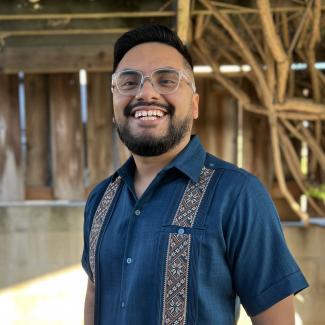
Specialization
Indigeneity and Immigration, North American West, US in the World, Chicana/o/x and
Latina/o/x history, Borders, Social Movements, Relational and Comparative Studies of Race,
Labor Studies, US and Mexican history, Oral History
Education
Ph.D. History, UC San Diego, 2021
M.A. History, UC San Diego, 2017
B.A. Black Studies and Sociology, UC Santa Barbara, 2014
A.A. Santa Rosa Junior College, 2011
Dr. Jorge Ramirez-Lopez is an assistant professor in the Department of Global Studies at the
University of California, Santa Barbara. He is a historian of Indigenous migration in North
America. He studies the crossings of Indigenous people from the Global South with the Global
North and how their lives intersect with Indigenous, Immigration, Chicana/o, Latina/o, and US
and Mexican history through a transnational and hemispheric lens. He teaches courses on global
Indigenous struggles and on global borders, culture and ethics, and social movements.
Previously, Dr. Ramirez-Lopez was a University of California President’s Postdoctoral Fellow at
the American Indian Studies Center at UCLA (2023-2025). He was also a Society of Fellows
postdoctoral scholar in the Department of Latin American, Caribbean, and Latino Studies at
Dartmouth College (2021-2023). Dr. Ramirez-Lopez received his Ph.D. and M.A. in History at
UC San Diego. He received his B.A. (High Honors) in Black Studies and Sociology (Distinction
in the Major) at UC Santa Barbara where he was trained within the Black Radical Tradition and
obtained an associate’s degree from Santa Rosa Junior College.
In his current book manuscript, Democracy from Below: The Communal Worlds Indigenous
Migrants Created, he follows the lives of Indigenous people from southern Mexico who were
among the first significant generation to labor along the US and Mexican Pacific Coast during
the 1980s and early 1990s. Drawing on oral histories, traditional and community archives,
government records and data, and personal collections in Mexico and the United States, Dr.
Ramirez-Lopez highlights the emergence of a cross-border grassroots movement centered on
Indigenous rights, autonomy, and multi-ethnic and multi-racial solidarity to confront the
neoliberal economic changes of the time.
Dr. Ramirez-Lopez’s scholarship has been generously supported by the Blum Center’s Central
Coast Regional Equity (CCRE) research award, the Mellon Foundation/UC President’s
Postdoctoral Fellowship Program UC-HSI Humanities Initiative, the Fulbright-García Robles
U.S. Student Program, the Social Science Research Council-DPDF, UC San Diego's (UCSD)
Chancellor’s Research Excellence Scholarships, Friends of the International Center Fellowship
(UCSD), the Center for U.S.-Mexican Studies (UCSD), and the Emerging Scholars of Program
at the University of Houston Downtown. His research has also received national recognition. He
was awarded the 2025 Carlton C. Qualey Memorial Award by the Immigration and Ethnic
History Society for the best journal article of 2024 in the Journal of American Ethnic History. He
received the 2024 UCLA Chancellor’s Award for Postdoctoral Research. His dissertation was
awarded the 2022 W. Turrentine Jackson Dissertation Award of the Pacific Coast Branch of the
American Historical Association, the 2022 Latinx Studies Section Dissertation Award of the
Latin American Studies Association (LASA), and an honorable mention for the 2022
LASA/Oxfam America Martin Dissertation Award. During his undergraduate training at UC
Santa Barbara, he received the 2014 Paul Robeson Award “Recognized by the Black Studies
faculty for excellent scholarship and community service.”
Dr. Ramirez-Lopez also writes about current Mexican Indigenous politics, immigration, and
labor issues in the United States and in Mexico. He is currently working on a project about
twenty-first century Indigenous land struggles and human rights violations in Oaxaca and a
second on a transnational social movement that interconnected the Pacific Coast between Mexico
and the United States in 2015. Dr. Ramirez-Lopez is Indigenous Triqui with cultural, social, and
familial ties to the town of Putla and the larger Mixteca region of Oaxaca, Mexico. He is a
member of the board of directors for the Centro Binacional para el Desarollo Indígena
Oaxaqueño (CBDIO) and an advisor to the Frente Indígena de Organizaciones Binacionales -
California (FIOB-CA).
Agrarian and Indigenous Studies Research Group:
Along with Ricado Jacobs and Paul Kohlbry, I am part of the Agrarian and Indigenous Studies
Research Group. We are a group of faculty in the Department of Global Studies committed to
supporting undergraduate and graduate research in the fields of agrarian and indigenous
studies. Our research covers the US/Latin America, Africa, and the Middle East and explores
topics including borders, class, food systems, labor, migration, political ecology, race,
rural/urban relations, social movements, techno-science and territory. We work within
decolonial and Marxist traditions, and use historical (archival and oral histories), sociological,
and ethnographic methods to understand the political horizons of contemporary agrarian and
indigenous struggles. For current or prospective students interested in exploring agrarian and
indigenous studies at UCSB, please check our course offerings and to get in touch with us with
any questions
List of Publications:
- “Our Dark Hands and Sore Backs: The Comité Cívico Popular Mixteco and the New
Grassroots Activism by Indigenous Mexican Migrants,” Journal of American Ethnic
History 43, no. 2 (2024): 5-33. 10.5406/19364695.43.2.01
- “Why Oaxaca? Why Now? The Political Currents of Indigenous Oaxacan Migrants in the
Twenty-First Century,” Aztlán: A Journal of Chicano Studies 48, no. 2 (Fall 2023): 179-
193. 10.1525/azt.2023.48.2.179
- “Epilogue: We Provide Food for Your Table: Triqui Farmworkers Organizing for
Change,” co-authored with Seth Holmes, in Seth Holmes, Fresh Fruit, Broken Bodies:
Migrant Farmworkers in the United States, Updated with A New Preface and Epilogue
(University of California Press 2023).
https://www.ucpress.edu/book/9780520398634/fresh-fruit-broken-bodies
- “Indigenous Harvest in Oaxacalifornia,” in Carissa Garcia and Yenedit Mendez, eds,
Boom Oaxaca: Conversaciones de Campo a Campo (The Press at California State
University, Fresno 2022). Co-authored with Xóchitl Flores-Marcial.
- “Archives of Indigenous Self-Activity: Capitalism, Violence, and Indigeneity in the
Americas,” Radical History Review, Special Issue on Militarism and Capitalism 133
(January 2019): 149-162. 10.1215/01636545-7160126
- “In Memoriam: Cedric Robinson, Modest Audacity, and the Black Radical Tradition,”
Kalfou: A Journal of Comparative and Relational Ethnic Studies 3, No. 2 (Fall 2016):
288-297. Co-authored with Jonathan D. Gomez and Ismael F. Illescas.
10.15367/kf.v3i2.108
Courses:
Global 110: Global Culture & Ethics (Spring 2027)
Global 140: Global Racial Justice (Not teaching for 2026-27)
Global 152: Global Indigenous Movements (Fall 2026)
Global 197: Global Borders (Spring 2027)